
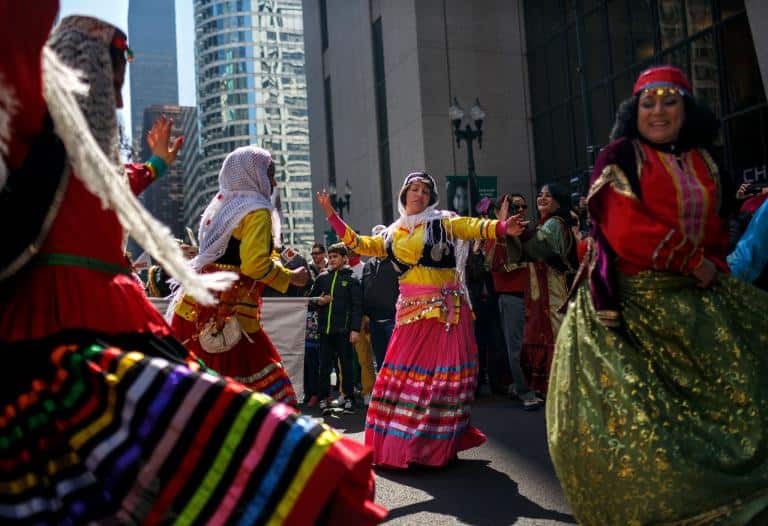
PHOTOGRAPH BY HOSSEIN FATEMI, PANOS PICTURES/REDUX
Iranian-Americans dance to bring in the new year at the 2016 Nowruz Festival in downtown Chicago.
Nowruz, also known as Persian New Year, has been observed for more than 3,000 years as the victory of spring over darkness.
FOR THE NORTHERN Hemisphere, March 19 is the first day of spring. But for 300 million people around the world, it’s the beginning of a new year, too. Nowruz—which means “new day”—is a holiday marking the arrival of spring and the first day of the year in Iran, whose solar calendar begins with the vernal equinox.
Nowruz has been celebrated in Iran and the Persian diaspora for more than 3,000 years. Its roots are as a feast day in Zoroastrianism, a religion practiced in ancient Persia that viewed the arrival of spring as a victory over darkness. The holiday survived the Islamic conquest of Persia in the seventh century and the decline of Zoroastrianism’s popularity, and it spread across the globe through the diaspora of Persian people throughout history. (Here’s how Persia became the world’s first true empire.)
Traditionally celebrated on the vernal equinox, many begin preparations for Nowruz weeks in advance. In the leadup to the holiday, people perform ritual dances and fill vessels in their home with water, which is associated with health, in an attempt to banish bad luck.

On the last Wednesday before Nowruz, many celebrate Charshanbe Suri, a night in which they jump over fire or go to doors banging spoons to scare away bad luck. People also visit cemeteries and bring offerings for the dead, whom some believe visit before the spring rite begins.
The spring festival’s focus is fertility and new life, so it’s appropriate that many revelers celebrate with seeds and eggs. Households set up tables covered with seven symbolic items they call haft-seen. Haft means “seven” and “seen” is “s” in Farsi, and all of the items start with the letter. These include seed sprouts (usually wheat, oats and other seeds, which symbolize rebirth), senjed (also known as silverberry or Persian olive, which is thought to spark love), garlic (protection), apple (fertility), sumac (love), vinegar (patience), and samanu, a pudding made of sprouted wheat (affluence). The table also can include a Koran, eggs, mirrors, and poetry.
Though Nowruz is old, the table tradition isn’t: As A. Shapur Shahbazi notes in Encyclopedia Iranica, it only came into effect in the last century.
 Blogs Notes
One Reply to “”